Pyramidal Lens Enables Mesoscale Structured Illumination: Breaking Through Projection Limits
To simultaneously see "wide" and "clear"? This is like taking a group photo with a phone - you want to frame everyone while keeping each face clearly visible. In cutting-edge research and industrial fields, this challenge is even more severe.

Recently, Assistant Professor Karl Zhanghao from the Faculty of Engineering at Eastern Institute of Technology, Ningbo and collaborators published a new research paper in the top international optics journal Optica, titled "Pyramidal lens enables mesoscale structured illumination by surpassing the spatial bandwidth limit of spatial light modulators".
Inspired by photography split-image lenses, the team innovatively designed a hexagonal pyramid lens that can generate and regulate mesoscale structured illumination with only a small projection chip, increasing the chip's effective pixels by over 100 times, providing a new solution for high-throughput super-resolution imaging and large-scale 3D measurement.
This pyramid lens has a simple structure, is easy to manufacture, and has low cost, with potential for wide application in optical imaging, machine vision, and industrial detection fields.
Fish and Bear's Paw: The Contradiction Between Wide Field-of-View and High Clarity
Structured illumination is one of the key technologies in 3D precision measurement and super-resolution microscopy. Its principle is to project alternating bright and dark sine stripes onto the sample surface, achieving super-diffraction-limit resolution or 3D morphology reconstruction through demodulation algorithms.
But there's a tricky contradiction: to simultaneously achieve high resolution and large field-of-view requires generating fine and large-area projection stripes, which places extremely high demands on the projection chip's pixel count. Current mainstream projection chips typically have pixel scales in the millions, which is far from sufficient for cutting-edge research and high-end industrial applications - "seeing wide" makes it difficult to "see clearly", and the two are hard to achieve simultaneously.
Flash of Inspiration: From Kaleidoscope to Split-Image Lens
Inspiration sometimes lies hidden in the most ordinary toys and tools. In a kaleidoscope, three mirrors cleverly reflect to transform a simple pattern into a brilliant symmetrical flower sea; screw a split-image lens onto a SLR camera lens, and city lights burst into a dreamy starry sky.
These phenomena inspired the research team: can we use exquisite reflective or refractive elements to regulate light paths, achieving clever control of complex light fields that far exceed the capabilities of the light source?
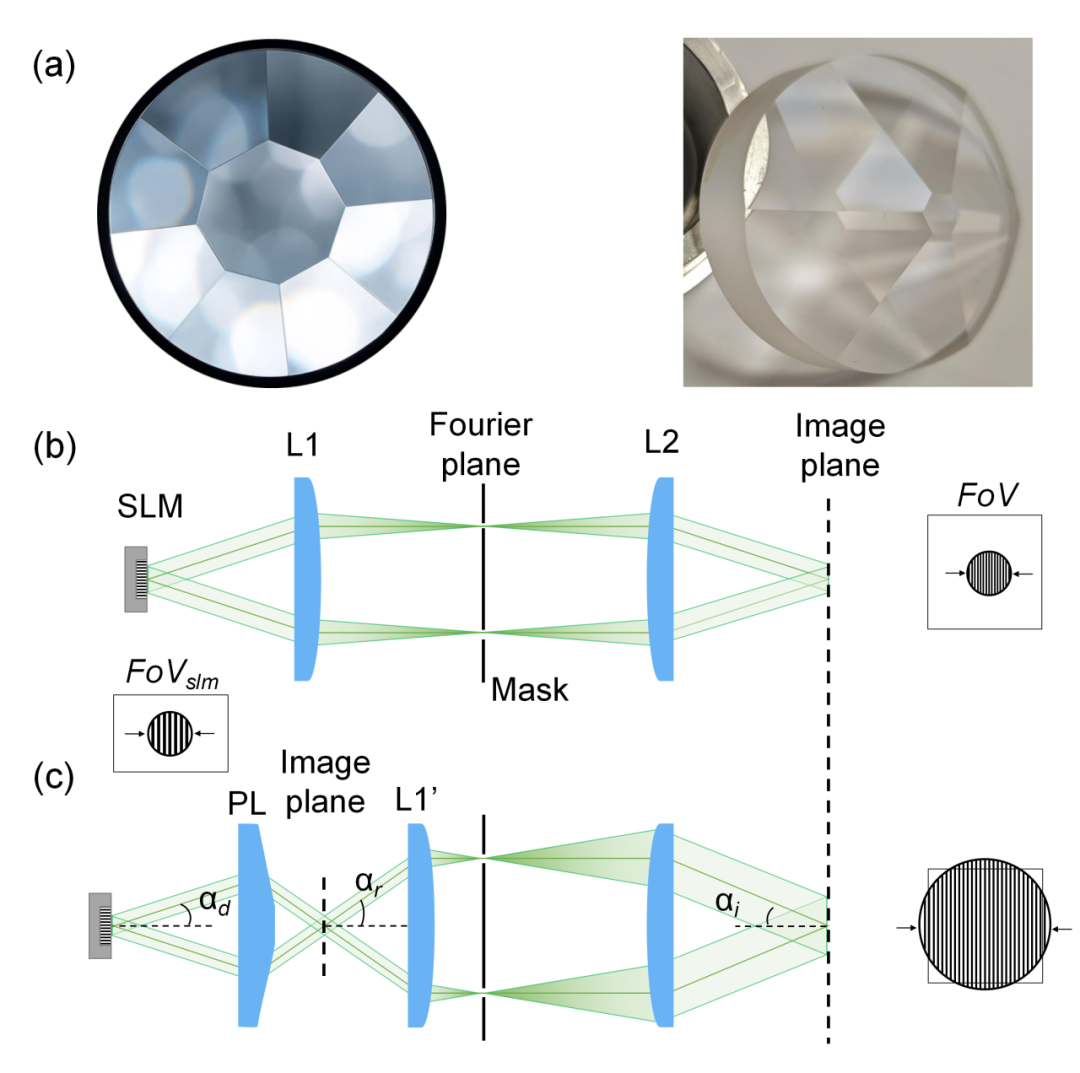
Figure 1: Photography split-image lens and custom-made hexagonal pyramid lens; demonstrating how the pyramid lens generates larger field-of-view fine stripes by refracting ±1st order diffracted beams.
Controlling Complexity with Simplicity: The Magic of a Piece of Glass
Inspired by this, researchers innovatively processed a piece of glass into a hexagonal pyramid shape. Placing it behind a micro-projection chip can precisely control the ±1st order diffracted beams emitted by the projection chip, deflecting them to larger angles. The larger the angle, the smaller the period of interference fringes formed by the two beams - that is, the stripes become finer and denser.
Thus, a small pyramid lens allows a projection chip that could originally only generate hundreds of stripes to generate thousands of fine stripes with the "magnification" effect of the pyramid lens, increasing the equivalent pixel count by over 100 times and achieving mesoscale structured illumination generation.
Furthermore, the hexagonal pyramid design can use the projection chip to precisely control the direction and phase of the stripes, achieving flexible regulation. Experimental videos clearly demonstrate that simply inserting the pyramid lens significantly expands the field of view of structured illumination and greatly increases stripe density.
The research team integrated this "pyramid lens + projection chip" solution into a structured illumination super-resolution microscopy system, creating a new super-resolution microscope - PyramidalSIM.
It uses only 600+ pixels of the projection chip to achieve 4K pixel super-resolution imaging that traditional methods require tens of thousands of projection pixels to accomplish; simultaneously achieving twofold resolution improvement, from widefield microscopy's 280nm to 138nm. This technology uses extremely simple optical elements to achieve efficient control of complex light fields, truly achieving "controlling complexity with simplicity." Without expensive high-pixel projection chips, simply adding a low-cost glass pyramid lens can simultaneously achieve both large scenes and high clarity.
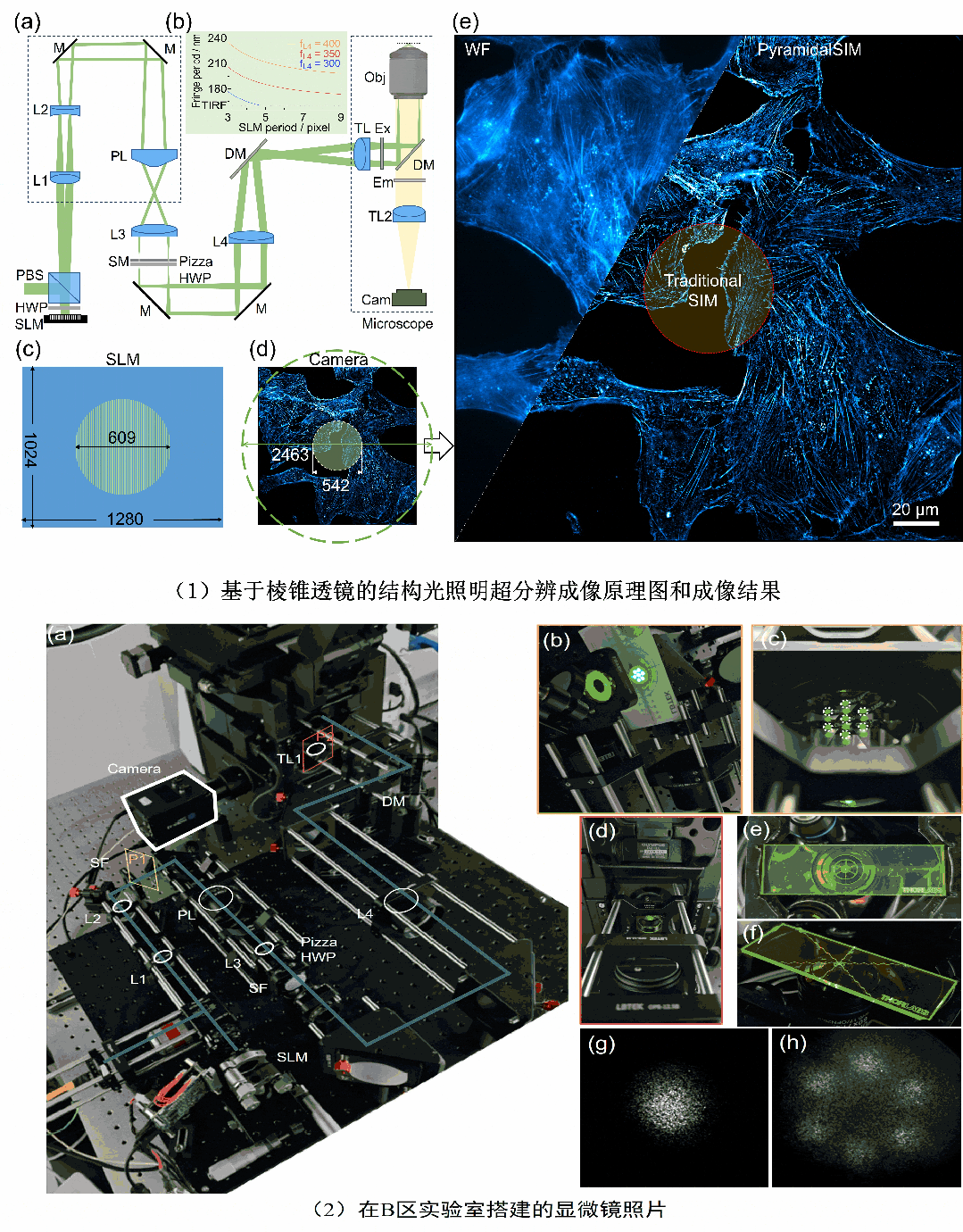
Figure 2 – Schematic diagram and imaging results of super-resolution imaging based on pyramid lens structured illumination; and the PyramidalSIM super-resolution microscope built in Lab B
Eastern Institute of Technology, Ningbo is the first affiliation of this paper, Assistant Professor Karl Zhanghao is the corresponding author, visiting scholar from Eastern Institute of Technology, Ningbo and associate researcher Wen Gang from Kunming Medical University, and PhD student Li Hongjin from City University of Hong Kong are co-first authors. Other collaborators include Professor Chen Shiqing from Chinese University of Hong Kong and Chair Professor Jin Dayong from Eastern Institute of Technology, Ningbo.
